


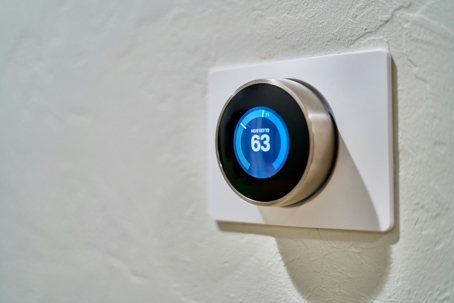
If your electric bill spikes every time Braintree hits a summer heat wave, you are not alone. Many homeowners watch the AC run for hours, yet still have rooms that feel stuffy upstairs and chilly downstairs. It can feel like the only options are to live with the discomfort or pay more than you want to keep the whole house cool.
Programmable thermostats give you a third option. Instead of one fixed temperature all day, you can let your AC work hardest when you are home and ease off when you are sleeping or away. Used the right way, this can trim your cooling costs and make your home feel more even, which matters in a place like Braintree where humid afternoons and cooler nights are common in summer.
At New England HVAC Pros, we have been working in New England homes for more than 45 years, so we have seen how much impact a simple thermostat change can have for local families. We regularly help Braintree homeowners adjust their settings or upgrade outdated thermostats so their AC runs smarter, not just harder. In this guide, we will walk through how programmable thermostats work in our climate, how to set them up for real savings, and when it makes sense to call us for help.
Why Programmable Thermostats Matter in Braintree’s Climate
Braintree summers are not the desert kind of hot. They are humid, with sticky afternoons that can feel much warmer than the thermometer shows, and evenings that often cool down. Spring and fall can swing from chilly mornings to warm afternoons on the same day. These temperature shifts are exactly where a programmable thermostat can help you stop overcooling your home.
With a basic manual thermostat, many people pick one number, such as 72 degrees, and leave it there all day and night. The AC starts and stops whenever the indoor temperature drifts above that, whether anyone is home or not. On a typical Braintree workday, that means you might be paying to keep an empty house at the same temperature you like in the evening when everyone is home and cooking, showering, and moving around.
A programmable thermostat lets you match your AC use to those daily patterns. You can set a slightly higher temperature during the day while the house is empty, then have the temperature ease back down before you get home. On cooler New England nights, you can often let the house warm a couple of degrees without anyone noticing, especially if you use ceiling fans in bedrooms. Over a whole season, trimming unnecessary cooling hours this way can make a real difference on your electric bills.
We have watched these patterns play out in Braintree for decades. Families who were constantly adjusting a manual thermostat or leaving it at one low setting, then worrying about bills, often see steadier comfort and fewer surprises once their thermostat is programmed around local weather and their routine. The climate will not change, but how your system responds to it can.
How Programmable Thermostats Improve AC Performance
To see why programmable thermostats help, it is useful to know what your thermostat really does. The thermostat measures the room temperature and compares it to the setpoint, which is the temperature you choose. When the room warms above the setpoint, it sends a signal to start the AC. When the room cools back down to the setpoint, it tells the AC to stop. That cycle repeats all day long.
With a single fixed setpoint, such as 70 or 72, your AC will cycle often on hot Braintree days, including when no one is home. On very humid days, that might keep the air comfortable, but on milder or partly cloudy days it can mean the system is running more than needed. A programmable thermostat changes the setpoint on a schedule, so it can be a little warmer during low use times and cooler when your family is active and needs more cooling.
This does more than just trim runtime. Proper scheduling can also improve how your system dehumidifies. AC units pull moisture out of the air best when they run for a reasonable stretch instead of turning on and off every few minutes. With a good schedule, you can encourage longer, steadier cooling periods at the times you care about most, such as early evening, instead of frequent short cycles all day.
Many energy organizations note that small temperature setbacks, such as 3 to 5 degrees for several hours, can help reduce cooling energy use over a season. The exact impact depends on your home, insulation, equipment, and habits, so no one can promise a specific number. What we typically see in Braintree homes is that when people move from a flat, low setpoint to a realistic schedule with modest setbacks, their AC does not have to work as hard to keep them comfortable.
In our experience, many comfort complaints that get blamed on the AC itself are really about how it is being controlled. Once we help homeowners program their thermostats around their real schedule and Braintree’s daily temperature swings, the system often feels stronger and more consistent without any mechanical changes. The thermostat is small, but it has a big say in how your AC behaves.
Real-World Scheduling Examples for Braintree Homes
One of the biggest hurdles we hear from homeowners is that they are not sure how to program the thermostat in the first place. The menus can look complicated, and no one wants to make the house uncomfortable by guessing. A few sample schedules can give you a starting point that you can tweak over time as you see what works for your family.
For a typical household that leaves for work and school during the day, you might try something like this in summer. From about 6 a.m. to 8 a.m., set the temperature at 72 to 74 while everyone is getting ready. From 8 a.m. to 4 p.m., let it rise to around 76 to 78 while the house is empty. From 4 p.m. to 10 p.m., bring it back to 72 to 74 while you cook, relax, and do chores. Overnight, many Braintree homes can be comfortable at 74 to 76, especially if bedrooms have fans.
If you are home during the day, such as retirees or people who work from home, you may not want as much of a daytime setback. You might keep the main living areas at 73 to 75 degrees from morning through early evening, then allow a small increase of a degree or two late at night. The key for at-home schedules is to make gentle adjustments instead of big jumps, so your comfort stays steady and the system has time to respond without long catch-up runs.
Weekends can follow a similar pattern, but many Braintree families prefer a bit more comfort during daytime hours when everyone is around. You might tighten the range by a degree or two, keeping it closer to your preferred evening setting all day. Then, as the weather cools in late August and September, you can gradually adjust these schedules so you are not cooling as aggressively on naturally mild days.
These are not rigid rules. They are starting points based on what we often set during thermostat visits in Braintree homes. The benefit of a programmable thermostat is that you can change things slowly. Try a schedule for a couple of weeks, see how your rooms feel and how often the AC seems to run, then nudge temperatures up or down in small steps until you find a balance you like.
Choosing the Right Programmable Thermostat for Your Braintree Home
Once you see the value of scheduling, the next question is which thermostat to buy. There are three broad categories most Braintree homeowners look at: basic programmable thermostats, Wi-Fi connected models, and learning or smart thermostats. They all control temperature, but they differ in how you interact with them and what features you get for the price.
Basic programmable thermostats let you set day-by-day schedules using buttons and a small screen on the wall. They tend to be more affordable and are often all that is needed if you prefer to set it and forget it. Wi-Fi thermostats add app control, so you can check and change settings from your phone. Learning thermostats go a step further by trying to learn your patterns and adjust automatically based on motion sensors, software, or even local weather data.
Compatibility with your existing system is the first thing to check. Most Braintree homes we work in have a furnace with central AC or a heat pump. Many modern programmable and smart thermostats need a common wire, often called a C wire, to provide constant low voltage power. Older systems or thermostats may not have this wire in place. That does not mean you cannot upgrade, but it does mean you may need a technician to confirm wiring options so you do not damage the equipment or end up with a thermostat that will not power up.
It is also easy to overbuy. Some top-tier smart thermostats are loaded with features that many families never use, such as advanced occupancy tracking or deep energy reports. For a lot of Braintree households, a simpler programmable model or a mid-range Wi-Fi unit that is easy to program can deliver nearly all the benefit at a lower cost. The focus should be on matching the thermostat to your home and your comfort style, not automatically picking the most expensive device on the shelf.
Because we are committed to affordable, customer-focused solutions, we often recommend mid-range options when they make more sense than high-end models. During a visit, we can look at your system type, wiring, and routine, then talk through which features you will actually use. The goal is to give you a thermostat that feels straightforward, so you will use its scheduling instead of giving up and running it like an old dial unit.
Avoiding Common Programmable Thermostat Mistakes
Even the best thermostat will not help if it is used in a way that works against you. One common mistake is setting extreme setbacks, such as letting the house reach the mid 80s during the day, then trying to pull it down to 70 right before everyone gets home. In many Braintree homes, especially those with older insulation or a lot of sun exposure, the system needs a long time and a lot of energy to recover from that big a jump.
Another pitfall is constantly overriding the program. If you regularly bump the temperature down several degrees whenever you feel warm, then raise it again when it gets too cool, you are basically turning your programmable thermostat into a manual one with less predictable behavior. The AC may cycle more often and comfort may feel uneven. A better approach is to make small, permanent changes to the schedule so the thermostat reflects your real preferences.
Thermostat placement is another issue we see on service calls around Braintree. If the thermostat is in direct sunlight, near a drafty door, or too close to a supply register, it will not read the true average temperature of your living space. That can cause the system to shut off too early, run too long, or start and stop more frequently than it should. A programmable thermostat cannot fix a bad location on its own.
Short cycling, where the AC turns on and off in quick bursts, can sometimes be tied to how the thermostat senses and responds to temperature changes in a poorly chosen location. If you suspect this is happening, a technician can evaluate both the system and the thermostat placement. We often find that relocating the thermostat or adjusting settings like the temperature differential, combined with a good schedule, can smooth out operation and improve comfort.
When we hear homeowners say that their programmable thermostat never seems right, it is usually one of these issues at play, not a defective device. By avoiding extreme setbacks, relying on planned schedule changes instead of constant overrides, and making sure the thermostat sits in a representative part of the home, you give the technology a chance to do what it is designed to do.
How Programmable Thermostats Fit Into Your Overall Energy Strategy
A programmable thermostat is a powerful tool, but it is only one piece of the comfort and efficiency puzzle. If your filters are clogged, your ductwork leaks into an attic, or your AC is undersized for the home, scheduling alone will not deliver the results you want. In fact, a struggling system may highlight underlying problems when you start paying closer attention to how often it runs.
On the other hand, when your equipment and ductwork are in good shape, a programmable thermostat can help you get the most out of them. Regular filter changes, clear outdoor units, and periodic tune-ups let your AC respond quickly and efficiently to thermostat commands. Pair that with a schedule that eases off while you are away and targets comfort when you are home, and you reduce both strain on the system and wasted energy.
It can help to think of this as an overall energy strategy for Braintree homes. You can start with low-cost steps like sealing obvious air leaks around windows and doors, changing filters on schedule, and setting up a moderate thermostat program. From there, we can help you decide whether deeper steps, such as duct repairs or equipment upgrades, make sense based on your comfort and energy goals.
When we visit a home to talk about thermostats, we do not just swap the device and leave. We check how the system is operating, ask about hot and cold spots, and look for signs that something more than control is at play. That way, you are not counting on a thermostat upgrade alone to fix what might be a maintenance or design issue, and you can make informed decisions about your whole system.
When to Ask a Local HVAC Pro for Help With Your Thermostat
Some Braintree homeowners are comfortable handling a thermostat upgrade on their own, but there are many times when bringing in a residential HVAC technician is the smarter move. If you are not sure what type of system you have, if your existing thermostat only has a couple of wires, or if you are considering a learning thermostat that needs a C wire, professional help can prevent wiring mistakes that might damage your equipment.
It can also be worth calling in when you have tried programming the thermostat and still feel like the house never settles at a comfortable temperature. That could be a sign of placement issues, settings that need fine-tuning, or underlying system problems. During a visit, we can verify wiring, confirm your system type, check basic operation, and walk you through setting a schedule that fits your daily routine instead of leaving you to guess.
A thermostat visit can include practical steps that many people do not realize are available. We can relocate a poorly placed thermostat to a better interior wall, adjust advanced settings that affect how sensitive it is to temperature changes, and make sure fan settings align with your comfort needs. We can also help you understand how long to expect the system to run after a setback, so you are not worried when you see longer cycles during recovery periods.
Because we offer 24/7 residential HVAC service, you do not have to wait through a heat wave if something is not right after a thermostat change. And because our mission is centered on customer satisfaction and fair, affordable pricing, our recommendations focus on what will genuinely help your home, not on selling you the most complex gadget in the aisle. Sometimes that means confirming that your current thermostat is fine and simply needs better programming.
Talk With New England HVAC Pros About Programmable Thermostats & Braintree Homes
A well-chosen, properly programmed thermostat is one of the simplest upgrades you can make to get more comfort and control from the AC you already own. In a place like Braintree, where humid summer days and cooler nights are part of life, aligning your cooling schedule with your real routine can cut down on wasted run time without sacrificing how your home feels.
If you would like help choosing a programmable thermostat, confirming compatibility, or setting up a schedule that fits your household, our team at New England HVAC Pros is ready to walk you through your options. We bring decades of New England residential HVAC experience, a focus on your comfort and budget, and 24/7 availability when you need us most. You do not have to figure out the menus or the wiring alone.
Call (508) 213-9472 to talk with us about programmable thermostats for your Braintree home.